

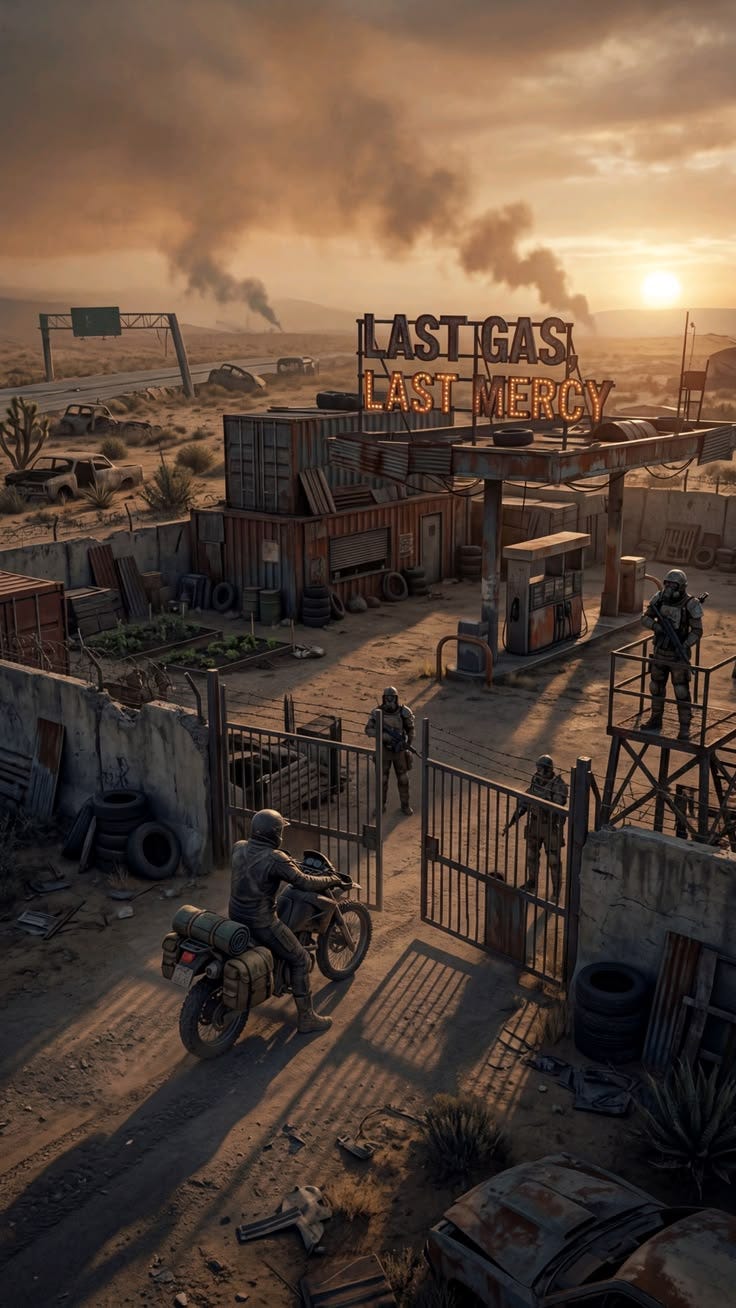
That image isn’t dystopian.
It’s early.
That’s the part people don’t want to admit. They still think collapse shows up with sirens and speeches and a clean line in the sand. It doesn’t. It creeps in wearing a receipt.
It starts small.
A dollar here.
Another dollar there.
And everyone shrugs like boiled frogs with smartphones.
“Supply chains.”
“Global markets.”
“Transition costs.”
“Temporary volatility.”
That’s the language of people explaining why you’re getting robbed with statistical confidence.
Meanwhile, out in the real world, the gas station turns into a border crossing.
Look at it.
Fences.
Armed guards.
Watchtower.
A man on a motorcycle negotiating access like he’s trying to smuggle oxygen.
That’s not fuel anymore. That’s permission.
Permission to move.
Permission to work.
Permission to exist beyond a 20-mile radius of your own shrinking life.
Marcus Aurelius wrote about controlling what you can and accepting what you can’t. Cute. Real stoic. But Marcus never had to decide between a full tank and groceries while some corporate ghoul explained it was “necessary.”
Nietzsche would’ve taken one look at that price board and said:
“Congratulations. You’ve successfully priced mobility into a moral test.”
And here we are, failing it like professionals.
The New American Math
Gas hits $5: outrage.
Gas hits $7: memes.
Gas hits $10: silence.
Gas hits $15: guards with rifles.
Because here’s the truth nobody in a suit wants to say out loud:
If you control fuel, you don’t need to control people. They’ll cage themselves.
You think this is about oil?
You think this is about policy?
No.
This is about movement.
The founders built a country where a man could get in a wagon and disappear west. Freedom was distance. Freedom was movement. Freedom was the ability to say, this place sucks, and go somewhere else.
Now?
Now they’ve figured out a better system.
Don’t ban movement.
Price it.
Make it just expensive enough that people stay put.
Make it just painful enough that they comply.
Make it just normalized enough that nobody riots.
It’s not tyranny.
It’s a subscription model.
Welcome to the Checkpoint Economy
Look at that sign again:
LAST GAS
LAST MERCY
That’s not branding. That’s prophecy.
Because mercy is gone.
There’s no mercy in $15 gasoline.
There’s no mercy in watching a paycheck evaporate into a pump that clicks like a metronome for your financial death.
There’s no mercy in being told:
“This is necessary.”
“This is progress.”
“This is the cost of the future.”
The future?
The future looks like a man in body armor telling you the minimum purchase is two gallons, because one gallon isn’t profitable enough to justify your existence.
That’s not economics.
That’s a filter.
A quiet, efficient system that sorts people into two categories:
Those who can move
Those who can’t
And once you can’t move…
You’re not a citizen anymore.
You. Are. Inventory.
The Absurdity We Pretend Not to See
We used to mock dystopian fiction.
“Mad Max? That’s ridiculous.”
“Society would never let it get that bad.”
Now?
Cars rot where they died.
People negotiate survival through bulletproof glass.
Men with rifles guard gasoline like it’s scripture.
And the best part?
People still log online and debate which side is to blame, like arguing over the chef while the house burns down around them.
George Orwell didn’t miss.
He just underestimated how willingly people would explain their own suffocation.
The Real Gut Punch
Here’s the part that stings.
This doesn’t end with riots.
It doesn’t end with revolution.
It ends with adjustment.
People don’t revolt.
They recalculate.
They drive less.
They shrink their lives.
They stop visiting family.
They stop taking risks.
They stop leaving.
They tell themselves:
“It’s not that bad.”
Until one day they look up and realize their entire world fits inside what they can afford to move.
No walls.
No chains.
Just a price high enough to make the cage feel like a choice.
Freedom didn’t disappear.
It just got a price tag most people can’t reach.
Final Word
Cicero warned that a nation can survive fools, even the ambitious.
But it cannot survive when the price of participation becomes the barrier to existence itself.
And that’s where we’re heading.
Not with a bang.
Not with a revolution.
But with a quiet little sign glowing in the dust:
LAST GAS.
LAST MERCY.
And a line of people pretending this is still normal.
Not because they believe it.
Because admitting it isn’t
would mean realizing they chose to stay, even when they could have left.
This is my favorite one of yours yet. Can feel the frustration, and the anger, and the mirror to our current existence. Amazing job.