
When Do We Say Enough Is Enough
As if "we" the American people really have a say in what our leaders do

Good Morning Eastern New Mexico,
Yemen is on my mind again. The Western press seems to have forgotten about this country. The less mature side of me would blame editors who pander to the wishes of those on the payroll of Saudi Arabian-backed companies or something shady like that. The adult side is convinced Saudi money and lobbyists greatly influence how the Western press functions. I will save this rabbit hole for follow-up commentary to allow time to examine the Yemeni debacle.
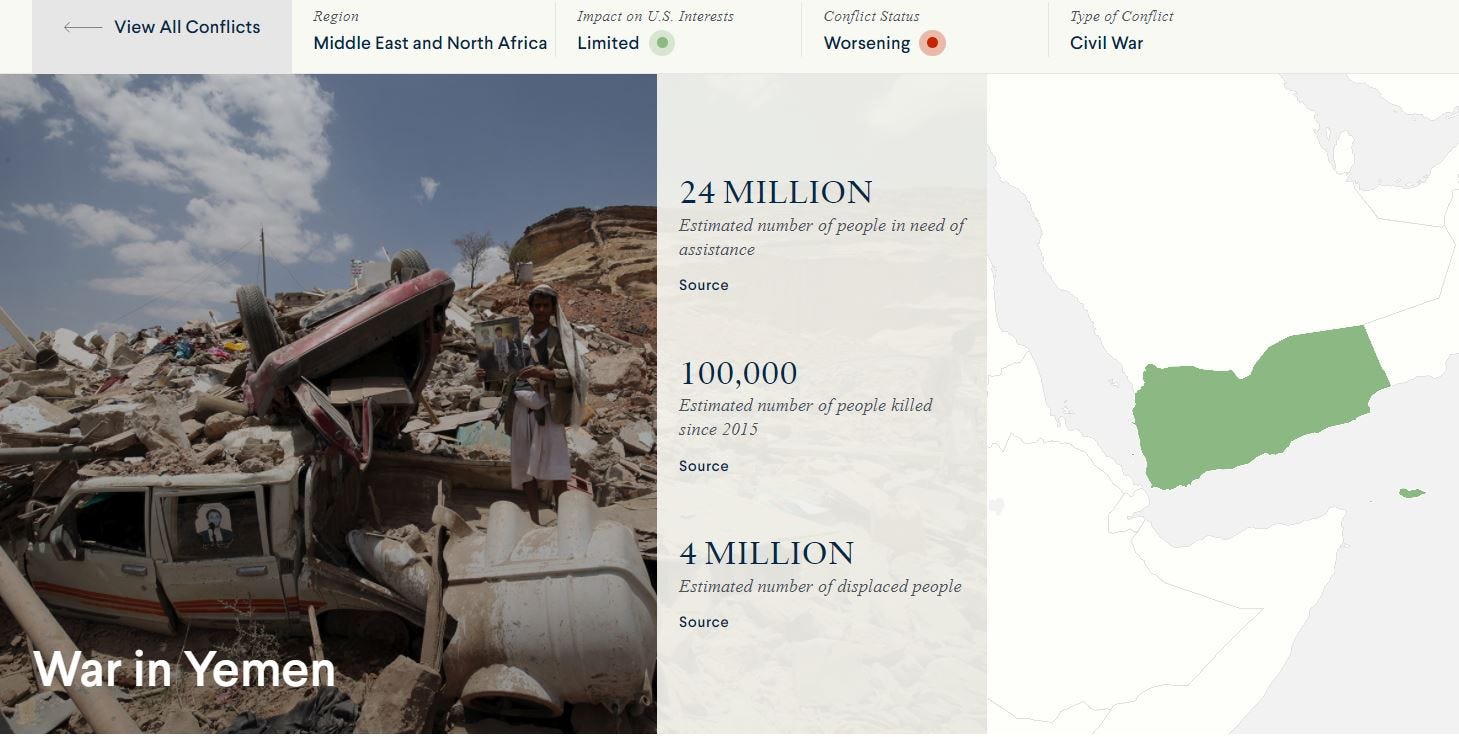
Here is a quick primer from the Council on Foreign Relations Global Conflict Tracker that was last updated on 30 December 2021 to get you up to speed on Yemen:
“Yemen’s civil war began in 2014 when Houthi insurgents—Shiite rebels with links to Iran and a history of rising against the Sunni government—took control of Yemen’s capital and largest city, Sana’a, demanding lower fuel prices and a new government. Following failed negotiations, the rebels seized the presidential palace in January 2015, leading President Abd Rabbu Mansour Hadi and his government to resign. Beginning in March 2015, a coalition of Gulf states led by Saudi Arabia launched a campaign of economic isolation and airstrikes against the Houthi insurgents, with U.S. logistical and intelligence support.”1
Interestingly, in 2015, The Wall Street Journal and Reuters characterized the Yemen-Saudi conflict as a proxy war between the United States and Russia, the U.S. backed Saudi Arabian government versus the Iranian backed Houthi government. Before we continue on this short journey of discovery, let’s revisit what a proxy war is:
“Prominent 20th-century political scientist Karl Deutsch defined “proxy war” as “an international conflict between two foreign powers, fought out on the soil of a third country, disguised as a conflict over an internal issue of the country and using some of that country’s manpower, resources, and territory as a means of achieving preponderantly foreign goals and foreign strategies.”2
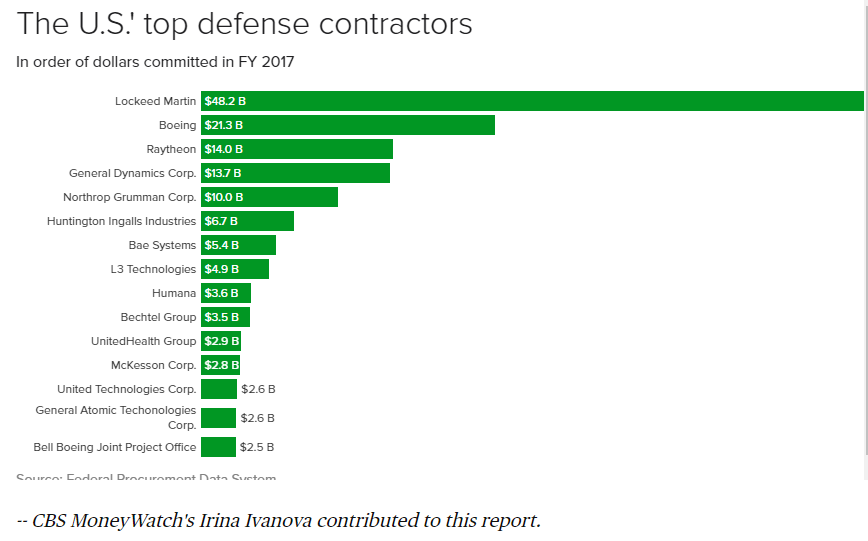
What’s missing from this description is the defense industry. I would characterize the relationship between a government and its defense-industrial complex as the tail wagging the dog. It is a simple yet complex relationship. I plan on diving much deeper into this relationship in future conversations but defer in order to allow time for a more cursory look at the almost seven-year conflict raging on Saudi Arabia’s southern border. Until I am able to devote a proper amount of research into the defense industry I would recommend a quick listen to the YouTube video in the link below or visit Amazon to buy Smedley’s book
War Is a Racket, Maj Gen Smedley Butler
Amazon link for War Is a Racket
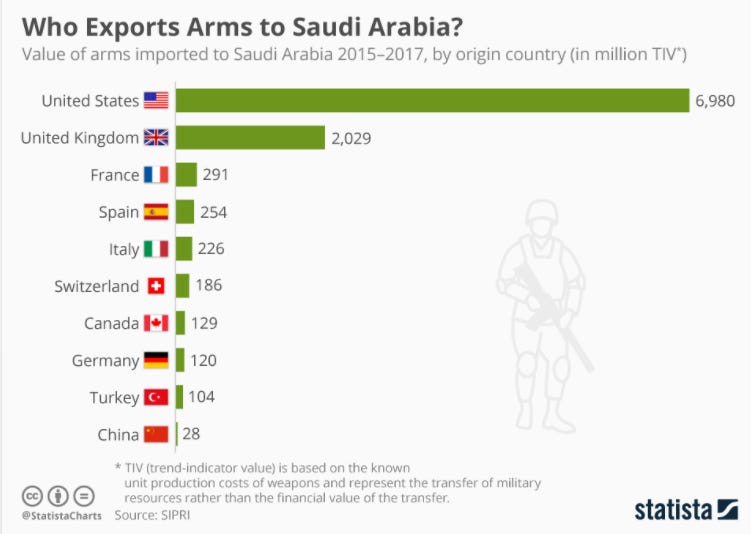
Fast-forwarding to January 2022, we find Saudi Arabia still [indiscriminately] bombing Houthi rebels and the Yemeni countryside at large. Thanks in large part to the American defense industry, the Saudis are never in short supply of precision weapons that enable this indiscriminate bombing. Making matters worse [if that is possible] the Saudi military admitted to using cluster bombs against Houthi rebels in Yemen: https://www.theguardian.com/world/2016/dec/19/saudi-arabia-admits-use-uk-made-cluster-bombs-yemen.
To add incongruence and dissonance to the use of cluster bombs, the Convention on Cluster Munitions turned 11 years old on 1 August 2021. This international treaty comprehensively bans cluster munitions and requires member countries to clear areas contaminated by cluster munition remnants within 10 years, destroy their cluster munition stocks within eight years, and provide assistance for victims. In the most two-faced manner possible, the United States speaks out of both sides of its mouth:
“…in November 2017, the Defense Department issued a new policy permitting the U.S. military to use all of the millions of cluster munitions in existing stocks, even the most unreliable types, “until sufficient quantities” of “enhanced and more reliable” versions are developed and fielded. The policy also facilitates U.S. acquisition of cluster munitions from foreign sources to replenish stocks. After rolling back civilian protections on cluster munitions, the Trump administration did the same for internationally banned antipersonnel landmines with its January 31, 2020 policy that has been condemned for allowing the U.S. to use landmines anywhere in the world in perpetuity.”3
Once again, I defer to the observation that I can’t make this shit up. My imagination is simply not complex enough to weave such a sordid tale. Each layer I peel back in researching this conflict reveals another easter egg. Quite frankly, every easter egg I have discovered is pungent with rot. *Note: I have no financial or familial ties to either Yemen or Saudi Arabia. The only qualifier I have is spending 18 months of my life in “The Kingdom” of Saudi Arabia “defending” our ally from the evil Iraqi hordes that threatened their oil fields. I cheekily refer to Middle Eastern oil as the drug of the people, in direct contradiction to Vladimir Lenin’s assertion that religion is the opium of the people.
Opium of The People, Vladimir Lenin
The human race is fucked up.
Give biologist Robert Sapolsky’s book, “Behave: The Biology of Humans at Our Best and Worst” a read to broaden your aperture on how broken we are as a species.
Humans Best and Worst, Robert M. Sapolsky
Bringing this conversation to a close, we find no short answers to solving the conflict in Yemen. There are too many forces acting against each other for a peaceful resolution. I look forward to engaging on this topic again but need more time to research data points to ensure we do not stray from empirical data and fully referenced “truths.” In keeping with tradition, I end this conversation with something snarky, yet relevant. I chose Vladimir Lenin, Bertrand Russell, and Robert Heinlein to share a thought:
“A lie told often enough becomes the truth.” Vladimir Lenin
“The whole problem with the world is that fools and fanatics are always so certain of themselves, and wiser people so full of doubts.” Bertrand Russell
“I never learned from a man who agreed with me.” Robert Heinlein
-Cheers,
Spike
Cook, Steven A., and Gordon, Phillip H., Council on Foreign Relations, Yemen Global Conflict Tracker, 30 December 2021. https://www.cfr.org/global-conflict-tracker/conflict/war-yemen
Porter, Gareth, the Globalist, “Is Yemen a Proxy War?”, 8 May 2015. https://www.theglobalist.com/is-yemen-a-proxy-war/
Wareham, Mary, Human Rights Watch, “Treaty Banning Cluster Munitions Turns 10, but Without the US. https://www.hrw.org/news/2020/07/31/treaty-banning-cluster-munitions-turns-10-without-us